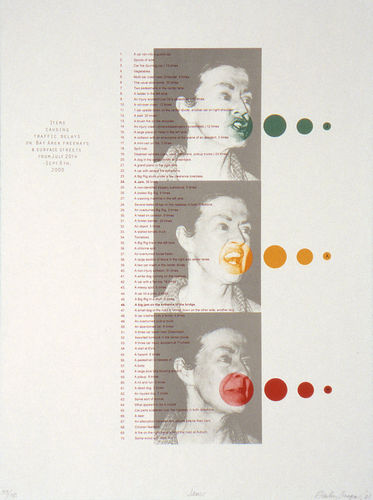
Close to the Bone presents a selected group of portraits by Bailey Doogan (1941–2022), drawn from the artist’s estate, while O’Keeffe at Home highlights a significant series of photographs of Georgia O’Keeffe (1887–1986), made at her New Mexico home in 1975 by Dan Budnik (1933–2020). Both artists explore age as lived experience, presenting the human body and the realities of middle age and later life with tender but unflinching honesty.
“Peggy Doogan (as I knew her) was the first non-photographic artist I exhibited after establishing the gallery, and her work embodied exactly what I wanted the gallery to stand for—intellectual rigor, technical mastery, and a willingness to confront difficult subjects. Bringing her artwork into conversation with Dan Budnik’s photographs of Georgia O’Keeffe allows us to look closely at two artists who address aging and agency from distinct perspectives. I am thrilled to collaborate with our friends at the University of Arizona Museum of Art and The Loft Cinema on these exhibitions.”
— Terry Etherton, President, Etherton Gallery
Long before contemporary debates around gender, body politics, and censorship, Bailey Doogan made these tensions central to her practice. Doogan is best known for her uncompromising representations of the aging human body—both women and men. Influenced by her upbringing in the Catholic Church, her career as a graphic designer (including redesigning the Morton Salt Girl logo), her 30-year tenure at the University of Arizona School of Art, and the feminist movement, she understood the power of symbols, language, and the psychology of human behavior. In Close to the Bone, iconic expressionist works such as If You Can Scream Loud Enough You Wake the Fish (1982) and Punch and Judy Stick It Out (1986) stand in conversation with more realist charcoal portraits of women such as GO (Virgin/Whore)(1989) and A Front (2002). These portraits demonstrate the artist’s understanding of “the real body” as “diaries of our experience,” marked by labor, motherhood, illness, and time. In a political and cultural climate that continues to scrutinize and regulate women’s bodies, Doogan’s work remains strikingly relevant.
Over the course of a five-decade career, photographer Dan Budnik documented important figures and moments of 20th-century America, including major Abstract Expressionist and Pop artists at work, pivotal moments in the Civil Rights Movement, the Hudson River restoration effort, and Native American communities in the Southwest. O’Keeffe at Home highlights a group of photographs made in 1975 during Budnik’s visits to O’Keeffe’s New Mexico home, when the artist was eighty-eight years old. Although long protective of her image, O’Keeffe allowed Budnik to photograph the intimacies of her daily life. The resulting images show her at home and at ease—on her patio, in the potting shed, after meals, and with her companion, Juan Hamilton. Budnik’s photographs demonstrate O’Keeffe’s vitality and engagement in later life, and provide a counterpoint to the perception that she had diminished with age.
Together, Bailey Doogan: Close to the Bone and Dan Budnik: O’Keeffe at Home offer a focused examination of aging, gender, and agency, presented in celebration of Etherton Gallery’s 45-year history.

